Shakespeare Workshop for 6 Year-Olds: Why Is It a Good Idea?

“Having a 6-year-old work on a Shakespeare comedy, sounds like a stunt, not reality.”

When DKL Studio first launched a workshop series for Shakespeare comedies, this was usually the first response that we received.

Then, we would ask a question back, “Is your 6-year-old good at making up stories?” Then all the parents would say, “Yes! He/she has an incredible talent for making up wild stories: dinosaur wars against chimp tribes, Captain America lost his shield, or maybe, a dragon searching for his courage.”

We will continue to ask, “Is your child familiar with phonics? Can he/she command basic daily life English words?” The parents would usually say, “Yes, my kid started learning phonics and basic vocabulary at age 5, just like most other kids.”

The last question, “Can your child use some basic sentence structures while speaking, and tell you some story parts that make sense?” Their answer is usually yes.

With all positive replies, a DKL teacher would advise that this child is actually equipped for story writing. A highly experienced DKL teacher would then guide this student on an imaginative adventure by piecing words into a string of phrases to shape a magical narrative from a pile of random thoughts.

Before stepping into the case study of a 6-year-old, let’s take a quick look at the all-time favorite novel by a professor from the School of Literature at Oxford University. Yes, we are talking about The Lion, the Wardrobe and the Witch by C. S. Lewis.

C. S. Lewis writes in a style that is magically beautiful and innocent. In his imaginary world, every plot piece is weaved seamlessly; every being, even the least influential character, is described in complex details.

C. S. Lewis casts a spell, then we all live in his world.
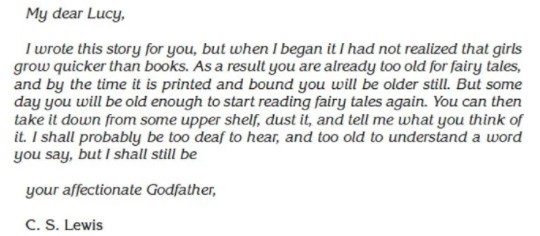
CS Lewis

Prelude: The Lion, the Wardrobe and the Witch

Lion Wardrobe Witch

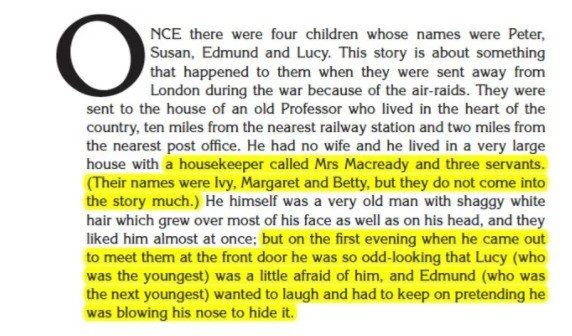
This is a part of the Prelude: an introduction of the characters. There are depictions of four house maids. The four maids, each with a name and a job post, was never a part of the plot. But no one would doubt that the maids really exist in the story. There he has it: the credibility of a storyteller.

Now, we are ready to share the story written by Erin (Age 6)

A Midsummer Night’s Dream

The task is “story telling based on cartoon illustrations”. A DKL teacher provides a collection of illustrations, and the student makes up a narrative based on her/his understanding of the characters, settings and events.

Characters

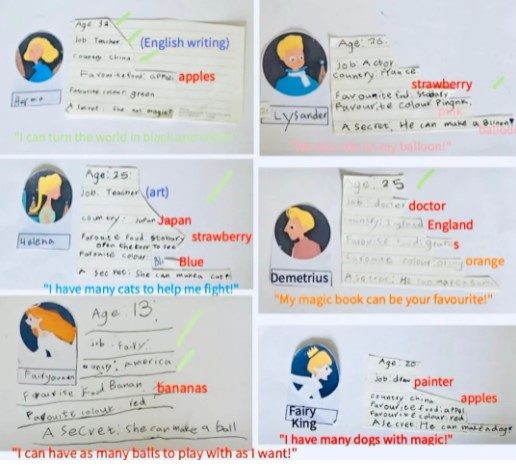
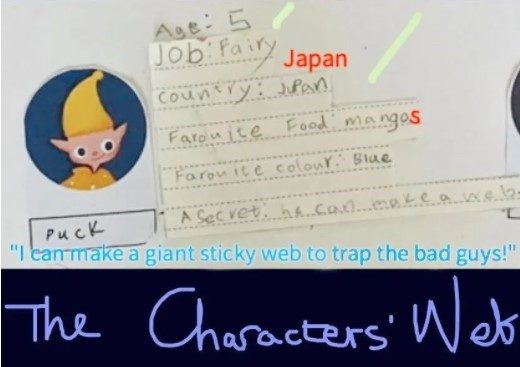
Character descriptions, created by Erin.

Hermia:

  • Age: 32
  • Job: teacher
  • Country: China
  • Favorite food: apples
  • Favorite color: green
  • A secret: She has magic
Characters

Advice from a DKL teacher:

What is her magic? Give some details such as:She can turn the world into black and white!

Magic

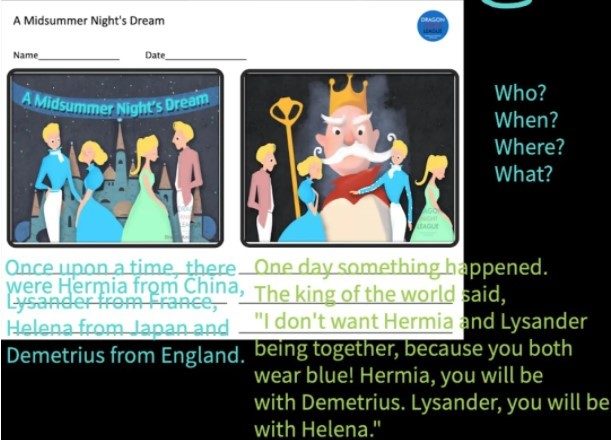
Just like any story telling workshops, the DKL teacher starts with the “Five W” questions:

Who? What? When? Where? Why?

Five W

Erin makes up her characters and creates a main conflict. Now, the story is developing.

When defining the characters, Erin decides that Hermia’s father looks like a “King of the World”. For a DKL teacher, this is a reasonable deviation from the original work: in ancient Greece, a father is as powerful as a king to his children. In this sense, Erin is right. The teacher decides to honor this idea.

Details, details, details!

Erin is painting a beautiful picture with words:
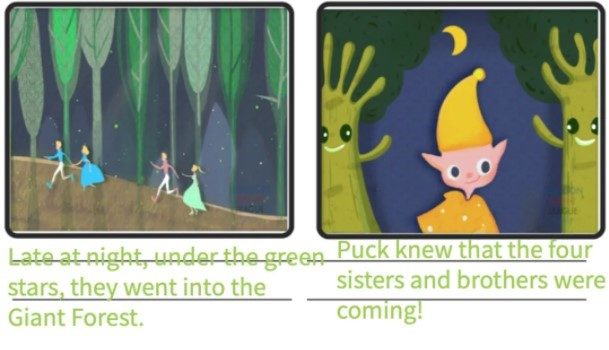
Late night, green stars, giant forest…

Details

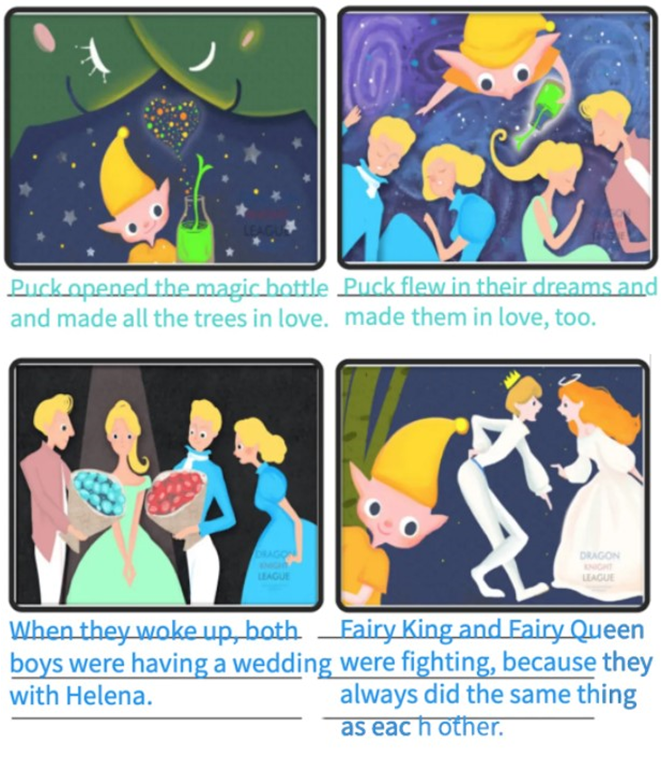
From the snuggling posture of two trees, Erin figured out the meaning of “falling in love”, and she gets really creative, in an adorable way!

PuckImages1

DKL Perspective

From a DKL perspective, the point of a Shakespeare story workshop is not “to study a masterpiece”, but to hold-hands with an intelligent kid, and to connect with the magically imaginative mind of a genius.

Shakespeare’s works demonstrated ground-breaking usage of the English language. He elevated the possibilities of English words at levels of anthropology, social studies, and linguistics. For centuries, people have regarded English as the “language of Shakespeare”.

In this sense, every child can play around with Shakespeare stories, right?

All DKL Insight Articles are original works by DKL Studio.
All Copyrights reserved for Dragon Knight League, LLC.