Decode Math Mysteries from Alice in Wonderland with a Mind-Mapping Approach
Among all parents who read Alice’s Adventure in Wonderland as a bed-time story, some of us have already learned the secrets:
This novel has a close relationship with America’s most beloved novel: A Wrinkle in Time
Alice’s Adventure in Wonderland is written by a Mathematician, and it is written for Mathematics.
The author of Alice’s Adventure in Wonderland was originally named Charles Dodgson, but he was widely known as Lewis Carroll. His longest job post was as a tutoring trainer for Math teachers at Oxford University. The character “Alice” was inspired by a real girl named Alice Pleasance Liddell, whose father was then the Dean of a school at Oxford. Lewis Carroll wrote a “love letter” to the Euclidian mathematic system, and disguised his scientific sentiment as a quirky adventure story decorated in a charming Victorian style.
According to Madeleine L’engle’s recount, Lewis Carroll’s approach inspired her to create A Wrinkle in Time. Many other writers and readers would honor Carroll with the same credit.
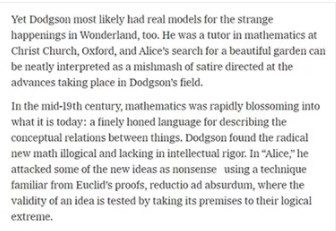
Alice’s Adventure in Wonderland casts irony to the new mathematic system that was about to dominate academia in the 19th century. As sophisticated in Euclidian math, as Lewis Carroll was, he was deeply perplexed and sad.
Even for the nerdier readers today, decoding the mathematic message from this novel would involve a lot of hair pulling, not to mention that the narrative is already heavy-loaded with symbolism, metaphors and quirky conversations.
DKL Mind Map
With a Tony Buzan approach, DKL teachers will create a mind map with students, and organize their ideas through this lovely but ever-intimidating classical work.
Step 1
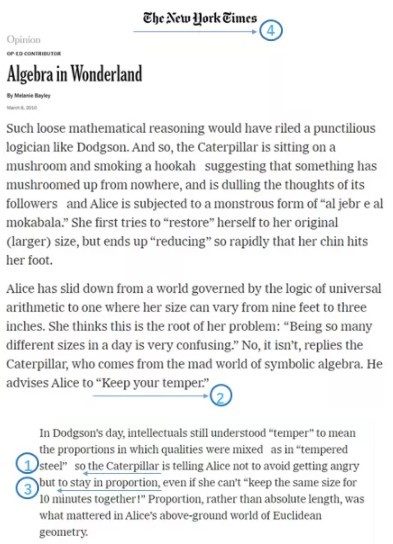
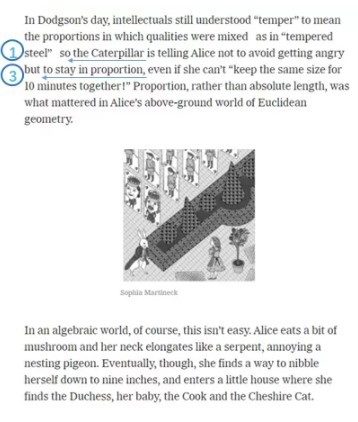
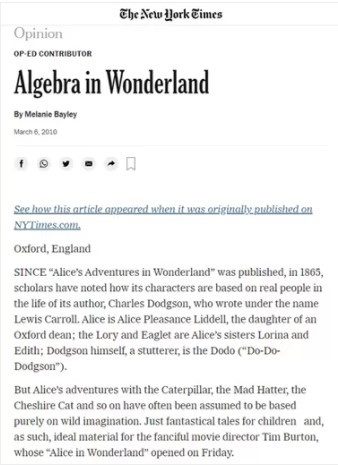
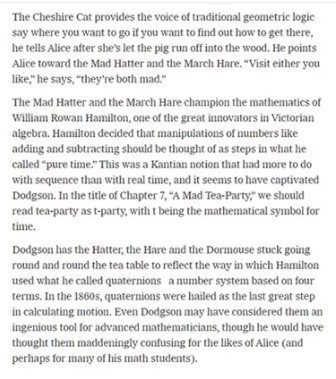
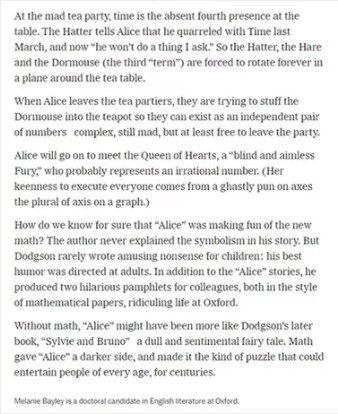
Select an analysis article with high academic credentials. On the mathematic core of Alice’s Adventure in Wonderland, there is a well-known analysis article by Melanie Bayley, a PhD Candidate at Oxford University. We will be mind-mapping the main ideas from this article, based on the version published in the New York Times.
Step 2
Assign a code to each topic, character, or situation. In the case of Melanie Bayley’s analysis article, she has structured the writing in such a pattern:
Mention a main character
Cite the words and actions by this character
Interpret the mathematic meaning of such words and actions
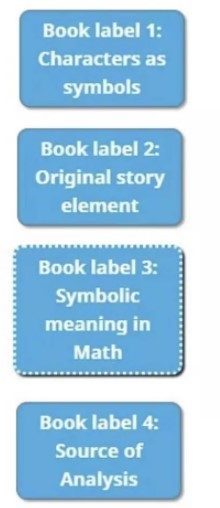
With this plan, we will assign one number to each character, and assign one number to each step of the writer’s analysis.
We see that inside this analysis article, it takes four numbers, and each number representing one step in the writer’s analysis:
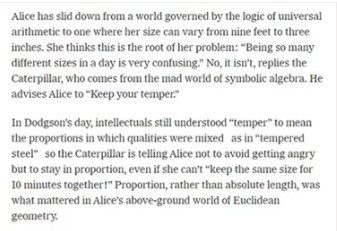
The character as symbol:The Caterpillar
The original story element:“Keep your temper.”
Symbolic meaning in Math:to stay in proportion
Source of analysis:The New York Times (NYT)
And throughout this article, five main characters will form the basic structure of a mind map.
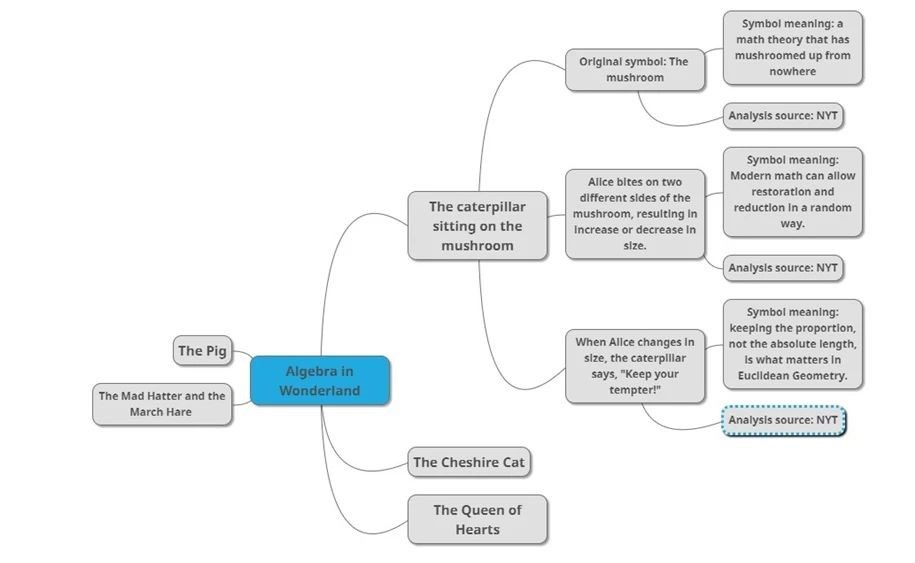
Now we move to all of the caterpillar’s symbolic elements from the analysis article. As you can see, each element is already labelled with a number.
All these elements will become sub-branches under the main branch “the caterpillar”.
As shown above, now all the symbols, actions and meanings are organized under the character “caterpillar”.
Now, applying the same logic to all five characters, we have a mind map for the main ideas of this NYT analysis article.
Finally, we need to beautify the mind map, to keep your brain smiling during an intensive reading phase.
One might argue that even with a mind map, there is still quite a lot of information to digest. However, without the simplifying function of a mind map, students would be looking at a daunting amount of words.
Full Text from the Original Article
Take a quick glance at the full text from the original article:
In the past 160 years, Alice’s Adventure in Wonderland has dazzled us, entertained us, and provoked us into deep thinking. We surrender ourselves to the Math genius hidden in an extravaganza of wild imagery, symbolism and underground mysteries.
Contrary to what many have suspected, Alice’s Adventure in Wonderland is not the manic murmur of a writer, but an “encoded love letter” from a passionate Math scholar to the Euclidian world of mathematics.
All DKL Resources Articles are original works by DKL Studio. All Copyrights reserved for Dragon Knight League, LLC.